
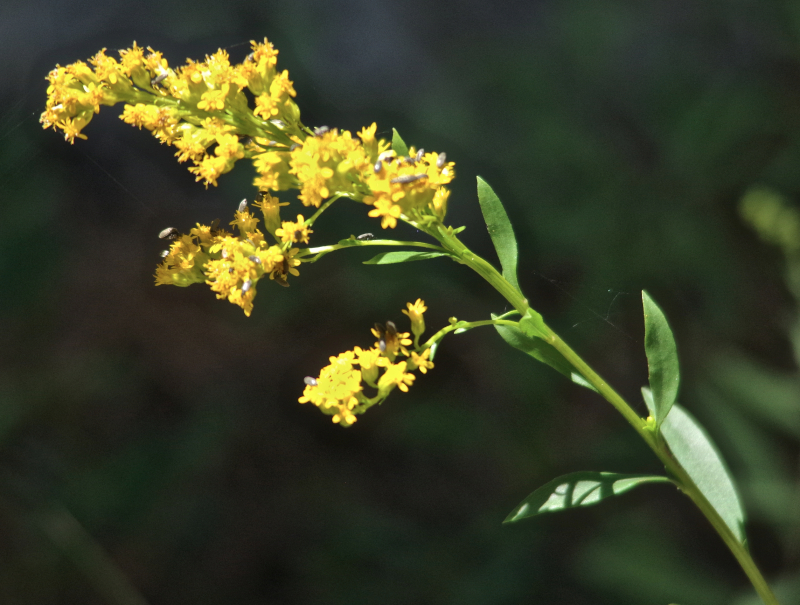
Botanical Name:
Solidago altissima
There are many other species in this genus.
Family: Compositae
Common Names:
Goldenrod
As this is a widespread plant in many areas of the world, there may be other common names. The herb community (almost) always refers to it as either Solidago or Goldenrod.
Part Used for Medicine:
Leaves and flowers
Habitat in Which it is Found/ Harvesting Season/ Special Considerations:
There are many species of Solidago in both the American Southwest and North America in general. A very common plant in the ponderosa forest and its many drainages. It is also very common along Oak Creek Canyon. The highest elevation at which it has been encountered in the southwest is 10,000′ in SW Colorado.
The bloom begins in early August and goes strong until the first frost in mid-September. The showy blooms makes one realize how common this plant is in the ponderosa elevations.
Goldenrod pollen is often (and mistakenly) connected to allergies. Pollen that causes allergies is almost always windblown, like Juniper. Insect pollinated plants have heavier pollen that is not carried by moving air and is much less diffuse. A close look at Goldenrod in bloom will reveal a plethora of insects hard at work. Of course, individual allergic reactions are always a possibility but this plant is not a primary seasonal cause of allergies as some believe. The blame for Solidago is usually more accurately directed to Ragweed (Ambrosia spp.).
It is best to harvest when in bloom.
Energy & Tastes:
Aromatic, astringent, bitter, dry
Chemistry:
The yellow blooms are high in flavonoids, especially Rutin.
Herbal Actions:
Diuretic
Decongestant
It generally works on fluid balance in the body
Anti-inflammatory to mucous membranes
Anti-oxidant
Indications:
Many folks are surprised to learn that Solidago is an effective decongestant and anti-inflammatory for overactive mucous membranes, especially in the upper respiratory tract and eyes.
While not specifically a pain killer, resolving the pressure and congestion from inflamed sinuses can bring pain relief.
Goldenrod provides a noticeable diuretic effect when used This property makes it a helpful addition to bladder infection formulas to keep the energy flowing down and out. It is also considered a tonic for the kidney/bladder system.
A lesser known use of Solidago is topical application in either an herb-infused oil or salve for sore, bruised or pulled muscles.
Herbal Combos:
With Yerba Santa and fresh Nettle tincture for seasonal allergies
As part of a larger formula for bladder infections, Solidago is used for its diuretic effect.
For topical use on muscles, can be combined with or substituted for Arnica.
Preferred Method of Preparation:
Usually tinctured fresh although other methods are possible. Fresh blooms and leaves are both used. Goldenrod honey is also a possibility: the astringent effect of honey supports the decongestant action of this plant.
For topical use, this plant can be made into an herbal infusion and used as is or in a salve.
https://plants.usda.gov/core/profile?symbol=SOAL6
The Plant Profiles are brief materia medica summaries of plants encountered during plant walks or introduced during class on our longer programs. They are presented here to help students organize plant info on an ongoing basis. Although the Profiles are not meant to be comprehensive, they are offered here to the public in the hope that others find these pages useful.